[Brazil] Predicted Formations for Ancelotti's New Cycle — Main A-Team for the First Australia Game, a Fully Rotated B-Team for the Second
2026-09-14
![[Brazil] Predicted Formations for Ancelotti's New Cycle — Main A-Team for the First Australia Game, a Fully Rotated B-Team for the Second](/_next/image?url=%2Fimages%2Fcolumns%2F%E3%83%96%E3%83%A9%E3%82%B8%E3%83%AB%E4%BB%A3%E8%A1%A8%E4%BB%A3%E8%A1%A8%E4%BA%88%E6%83%B3%E3%83%95%E3%82%A9%E3%83%BC%E3%83%A1%E3%83%BC%E3%82%B7%E3%83%A7%E3%83%B3en.png&w=3840&q=90&dpl=dpl_E7jyD3tWmsVDHoxkjrbKHRHjpFd9)
Beaten by Norway in the World Cup round of 16 — Brazil's first exit at that stage in 36 years — Carlo Ancelotti has kept his job and launched a "new cycle", leaving out 17 of his 26 World Cup players and calling up eight uncapped names in a squad averaging around 24 years old. Based on the 26 players named for two games against Australia on 25 and 29 September and a first-ever meeting with India on 3 October, we predict a first-choice A-team for the opening Australia match and an entirely rotated B-team for the second, played just three days later.
On 9 September the Brazilian Football Confederation (CBF) named Brazil's first squad since the World Cup. Carlo Ancelotti, confirmed to stay on, takes the team to Australia for two away games on 25 and 29 September before a first-ever meeting with India in Kolkata on 3 October. With most of the World Cup group left out and a wave of youngsters and first call-ups brought in, this squad is the starting point of a new cycle aimed at the 2028 Copa América and the 2030 World Cup. Playing the same opponent twice in three days is the ideal way to measure the established players and the newcomers against the same yardstick. We lay out two predicted line-ups: an A-team of first-choice players for the first Australia game on 25 September, and a B-team with all eleven changed — which we think is likely — for the second on 29 September.
Knocked Out by Norway — Brazil's First Round-of-16 Exit in 36 Years
At the 2026 World Cup Brazil drew 1-1 with Morocco in Group C, then beat Haiti 3-0 and Scotland 3-0 to top the group on seven points. In the round of 32 they came from behind to beat Japan 2-1 after Kaishu Sano's opener. But two goals from Norway's Erling Haaland in the round of 16 sent them out 1-2; a late penalty from substitute Neymar was not enough. It was Brazil's first exit at that stage since 1990, and the lack of possession and the second-half substitutions drew fierce criticism at home.
Brazil at the 2026 World Cup
| Round | Opponent | Result | Score |
|---|---|---|---|
| Group MD1 | Morocco | D | 1-1 |
| Group MD2 | Haiti | W | 3-0 |
| Group MD3 | Scotland | W | 3-0 |
| Round of 32 | Japan | W | 2-1 |
| Round of 16 | Norway | L | 1-2 |
Ancelotti Stays — "Not an End, but the Start of a New Cycle"
The backlash was strong, with Romário calling for his dismissal, but the CBF made clear it would honour Ancelotti's contract through the 2030 World Cup. After the Norway defeat Ancelotti said the loss was not an end but the beginning of a new cycle, naming the 2028 Copa América as the near-term target and the 2030 World Cup as the long-term goal.
17 World Cup Players Out, Eight Uncapped In — Average Age Down From 29 to About 24
At the 9 September press conference Ancelotti stressed the need to prepare a new generation of players for the national team and signalled a shift of focus towards youth. Only nine of the 26 World Cup players remain, including Marquinhos, Gabriel Magalhães, Bruno Guimarães, Vinícius Júnior and Raphinha. He also said the door is closed to no one, and that if Alisson is still Brazil's best goalkeeper at the next Copa América, he will play. Reports put the squad's average age at around 24, down from about 29 at the World Cup.
We need to prepare a new generation of players for the national team.
Carlo Ancelotti (squad announcement, 9 September; translated from Brazilian media reports)
Brazil squad for the September/October window (26 players)
| Pos | Players (club) |
|---|---|
| GK | Hugo Souza (Corinthians), Pedro Morisco (Coritiba)*, Otávio (Cruzeiro)* |
| DF | Marquinhos (PSG), Gabriel Magalhães (Arsenal), Douglas Santos (Zenit), Wesley (Roma), Vitor Reis (Manchester City), Jair (Nottingham Forest)*, Mauro Júnior (PSV)*, Matheuzinho (Corinthians)*, Arthur Dias (Athletico-PR)* |
| MF | Bruno Guimarães (Arsenal), Andrey Santos (Manchester United), Douglas Luiz (Juventus), Danilo Santos (Botafogo), Breno Bidon (Corinthians)*, Gabriel Bontempo (Santos)* |
| FW | Vinícius Júnior (Real Madrid), Raphinha (Barcelona), Endrick (Real Madrid), Estêvão (Chelsea), João Pedro (Chelsea), Rayan (Bournemouth), Pedro (Flamengo), Samuel Lino (Flamengo) |
* First call-up. The 17 left out include World Cup regulars Alisson, Ederson, Casemiro, Neymar, Danilo, Lucas Paquetá and Matheus Cunha. Rodrygo and Éder Militão are injured. The goalkeeping group was changed completely to give young keepers experience. In the summer window Bruno Guimarães moved from Newcastle to Arsenal and Andrey Santos from Chelsea to Manchester United, while Endrick returned to Real Madrid after a loan at Lyon.
Fixtures and Opponents — Two Games With World Cup Last-32 Side Australia, and a First-Ever Meeting With India
Brazil's international friendlies, September-October 2026 (kick-off in Japan time)
| Date | Opponent | Venue | Kick-off (JST) |
|---|---|---|---|
 Fri 25 Sep Fri 25 Sep | Australia | Queensland Country Bank Stadium (Townsville) | 19:00 |
| Tue 29 Sep | Australia | Suncorp Stadium (Brisbane) | 19:00 |
 Sat 3 Oct Sat 3 Oct | India | Salt Lake Stadium (Kolkata) | 23:00 |
Tony Popovic's Australia finished second in World Cup Group D before losing to Egypt on penalties in the round of 32, and he has promised new faces for the Brazil games. Brazil lead the head-to-head record with seven wins, one draw and one defeat (nine matches, per Wikipedia), the most recent a 4-0 win in Melbourne in June 2017. Australia's only win came 1-0 in the third-place play-off at the 2001 Confederations Cup.
India, coached by Khalid Jamil, are ranked 138th in the world against Brazil's fifth, and this will be the first meeting between the two nations. Billed at home as the biggest game in Indian football history, Jamil has welcomed it, saying high-profile matches like this can be good for Indian football.
Prediction A: vs Australia, 25 Sep — A 4-2-3-1 Built on the Nine Survivors
Ancelotti switched between 4-3-3 and 4-2-3-1 at the World Cup, but with Casemiro gone we expect a 4-2-3-1 with Bruno Guimarães and Andrey Santos as the double pivot. With every World Cup goalkeeper left out, capped Hugo Souza is the favourite in goal. Captain Marquinhos and Gabriel Magalhães form the centre-back pairing, with veteran Douglas Santos at left-back and Roma's Wesley on the right. Vinícius Júnior plays off the left, Raphinha — scoring freely in LaLiga this season — in the number 10 role, and 19-year-old Estêvão on the right, with João Pedro, who missed the World Cup squad, leading the line. It is a line-up that puts the World Cup core and the next generation on the same pitch to test the new cycle's backbone.
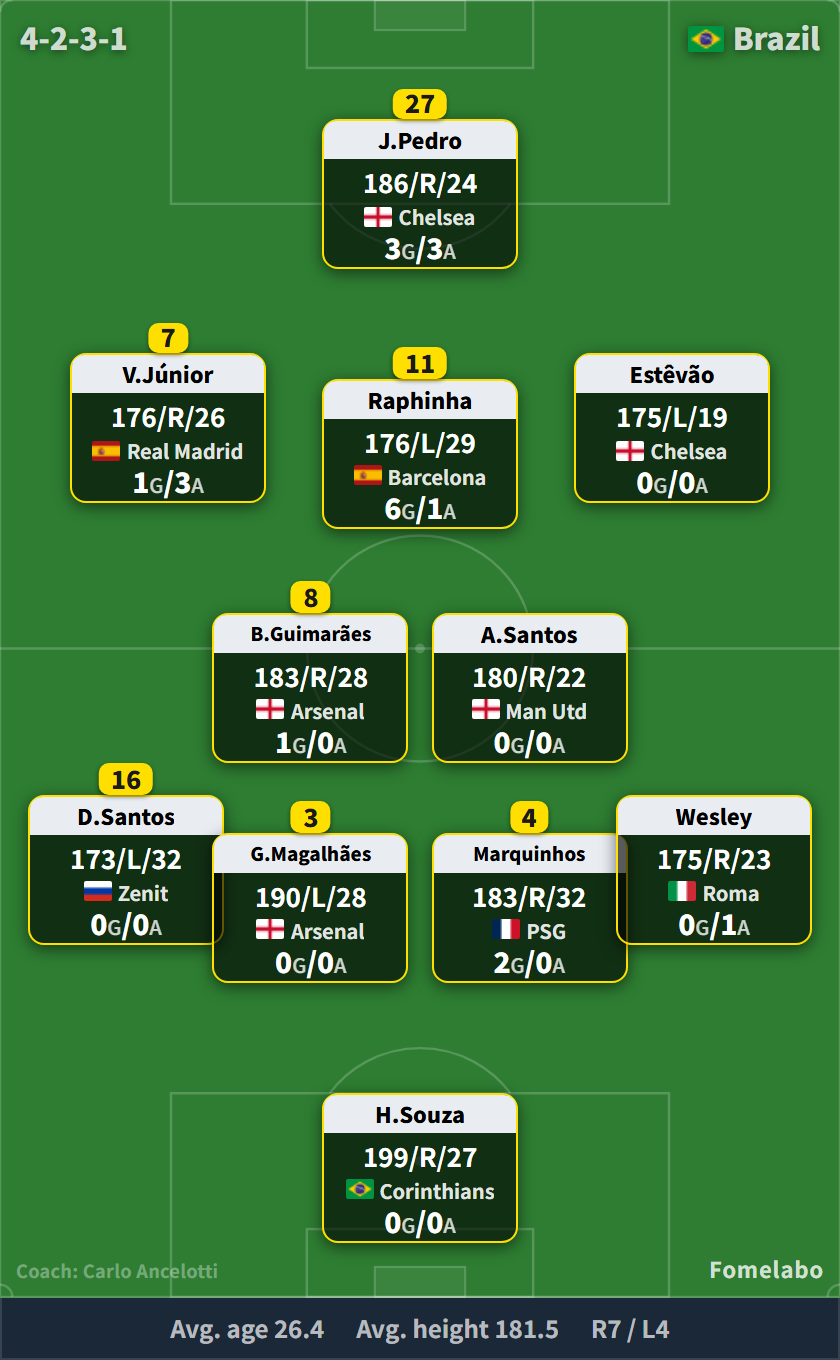
Predicted A-team vs Australia, 25 Sep (4-2-3-1)
| Pos | Player | Club | Notes |
|---|---|---|---|
| GK | Hugo Souza | Corinthians | The only capped keeper in the squad; 199cm |
| LB | Douglas Santos | Zenit | World Cup squad member; 32-year-old experience for a young back line |
| LCB | Gabriel Magalhães | Arsenal | Left-footed centre-back and a set-piece threat |
| RCB | Marquinhos | PSG | Captain and leader of the transition |
| RB | Wesley | Roma | 23-year-old attacking right-back |
| DM | Bruno Guimarães | Arsenal | Joined Arsenal this summer; the new midfield anchor |
| DM | Andrey Santos | Manchester United | 22 years old; a candidate to succeed Casemiro |
| LW | Vinícius Júnior | Real Madrid | Four World Cup goals; the undisputed attacking star |
| AM | Raphinha | Barcelona | Scoring freely in LaLiga this season |
| RW | Estêvão | Chelsea | 19 years old; a leading light of the next generation |
| CF | João Pedro | Chelsea | Recalled after missing the World Cup; first choice up front |
Prediction B: vs Australia (second game), 29 Sep — All Eleven Changed Three Days Later to Test First Call-Ups and Brasileirão Players
For a coach who has made assessing young players his top priority, facing the same Australia side again three days later is the perfect chance to compare the first-choice XI directly with the newcomers. So we think the second game is likely to feature a B-team with all eleven changed. Twenty-year-old Otávio starts in goal. The entire back four are first call-ups: PSV's Mauro Júnior at left-back, 19-year-old left-footer Arthur Dias and 198cm Jair at centre-back, and Corinthians' Matheuzinho at right-back. Twenty-one-year-old Breno Bidon partners the experienced Douglas Luiz in midfield, with Samuel Lino on the left, 21-year-old Gabriel Bontempo in the number 10 role and 20-year-old Rayan on the right. Up front is Pedro, with 15 goals in the Brasileirão this season and among the league's top scorers. How well the newcomers cope with the pace and intensity of a World Cup last-32 side could shape the pecking order from here on.
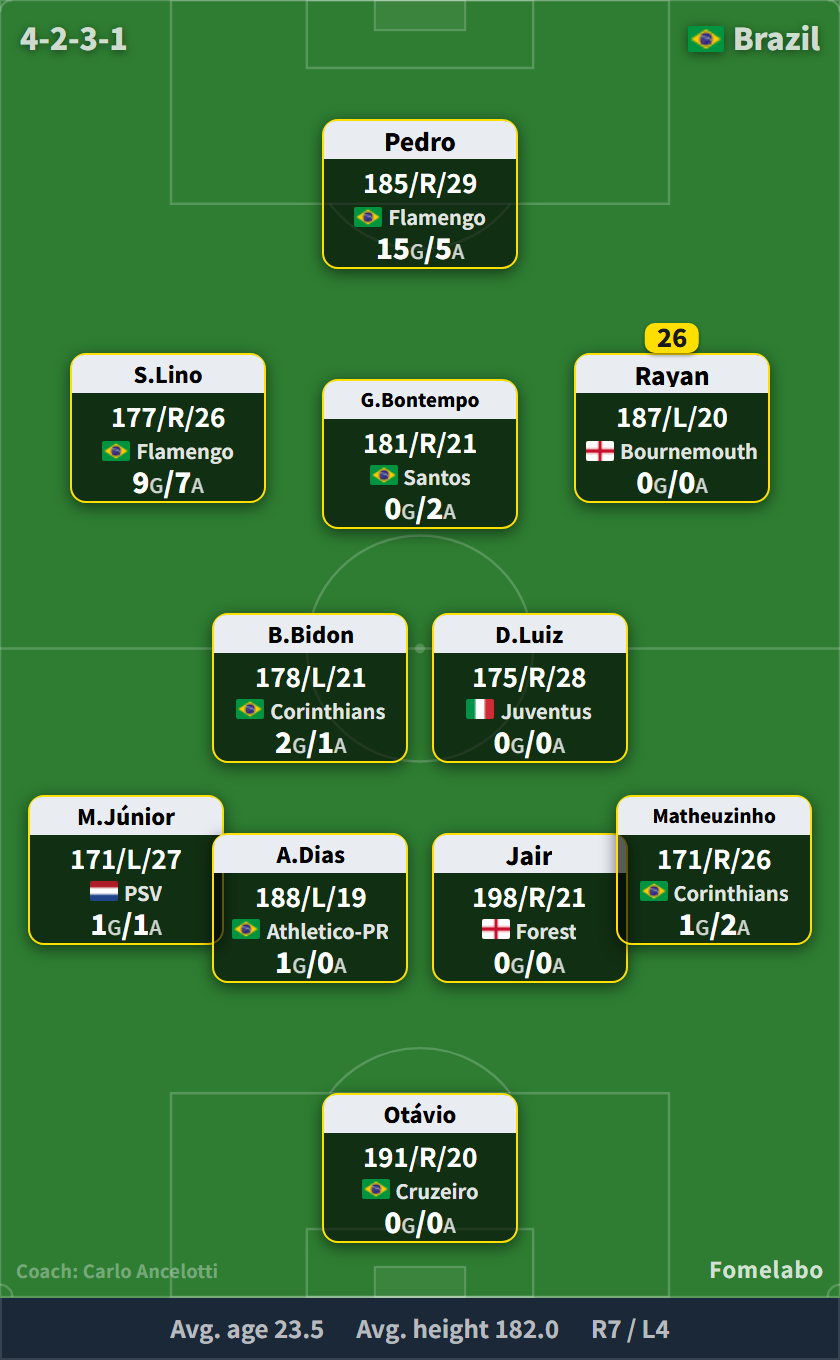
Predicted B-team vs Australia (second game), 29 Sep (4-2-3-1)
| Pos | Player | Club | Notes |
|---|---|---|---|
| GK | Otávio | Cruzeiro | First call-up at 20; Cruzeiro's first-choice keeper |
| LB | Mauro Júnior | PSV | First call-up; left-footed full-back |
| LCB | Arthur Dias | Athletico-PR | First call-up at 19; left-footed centre-back |
| RCB | Jair | Nottingham Forest | First call-up; towering 198cm centre-back |
| RB | Matheuzinho | Corinthians | First call-up; one of Brazil's best domestic right-backs |
| DM | Breno Bidon | Corinthians | First call-up at 21; left-footed playmaker |
| DM | Douglas Luiz | Juventus | Experience to settle a young midfield |
| LW | Samuel Lino | Flamengo | 9 goals, 7 assists this season; direct dribbling is his main weapon |
| AM | Gabriel Bontempo | Santos | First call-up at 21; attacking midfielder |
| RW | Rayan | Bournemouth | 20 years old; left-footed winger |
| CF | Pedro | Flamengo | 15 Brasileirão goals this season |
India, 3 Oct — A Mixed Side Built on What the Two Australia Games Reveal?
After a long trip from Australia to India, the third match is likely to bring a side that mixes players from both the A- and B-teams, based on what Ancelotti learns from the double-header. If first call-ups who impress against Australia line up alongside the A-team regulars, it will be a sign that the pecking order is starting to shift. For India, ranked 138th, it is a first-ever meeting with Brazil, and a big crowd is expected at Kolkata's Salt Lake Stadium.
Rearrange the B-team line-up on Fomelabo (India vs Brazil)Summary — Can Brazil Win While Renewing the Generation?
For Brazil, a round-of-16 exit is judged as nothing less than failure, and Ancelotti has responded with a bold overhaul for his first three games since. Can he get results with the core he kept while giving the newcomers a place? The shape of a new Seleção aimed at the 2028 Copa América and the 2030 World Cup should start to emerge over these three autumn fixtures.
Note: predicted formations are Fomelabo's own. Shirt numbers are from the 2026 World Cup; newly called-up players had no numbers at the time of writing (14 September 2026). Clubs and statistics are as of the same date (league matches only: 2026-27 in Europe, 2026 season in the Brasileirão). On Fomelabo's match pages, both Australia games (25 and 29 September) show the A-team predicted XI and the India match shows the B-team.
Build your own Brazil formation on Fomelabo