Japan National Team Schedule to 2034: How the Even-Year Asian Cup and an AFC Nations League Would Change the Calendar
2026-09-27
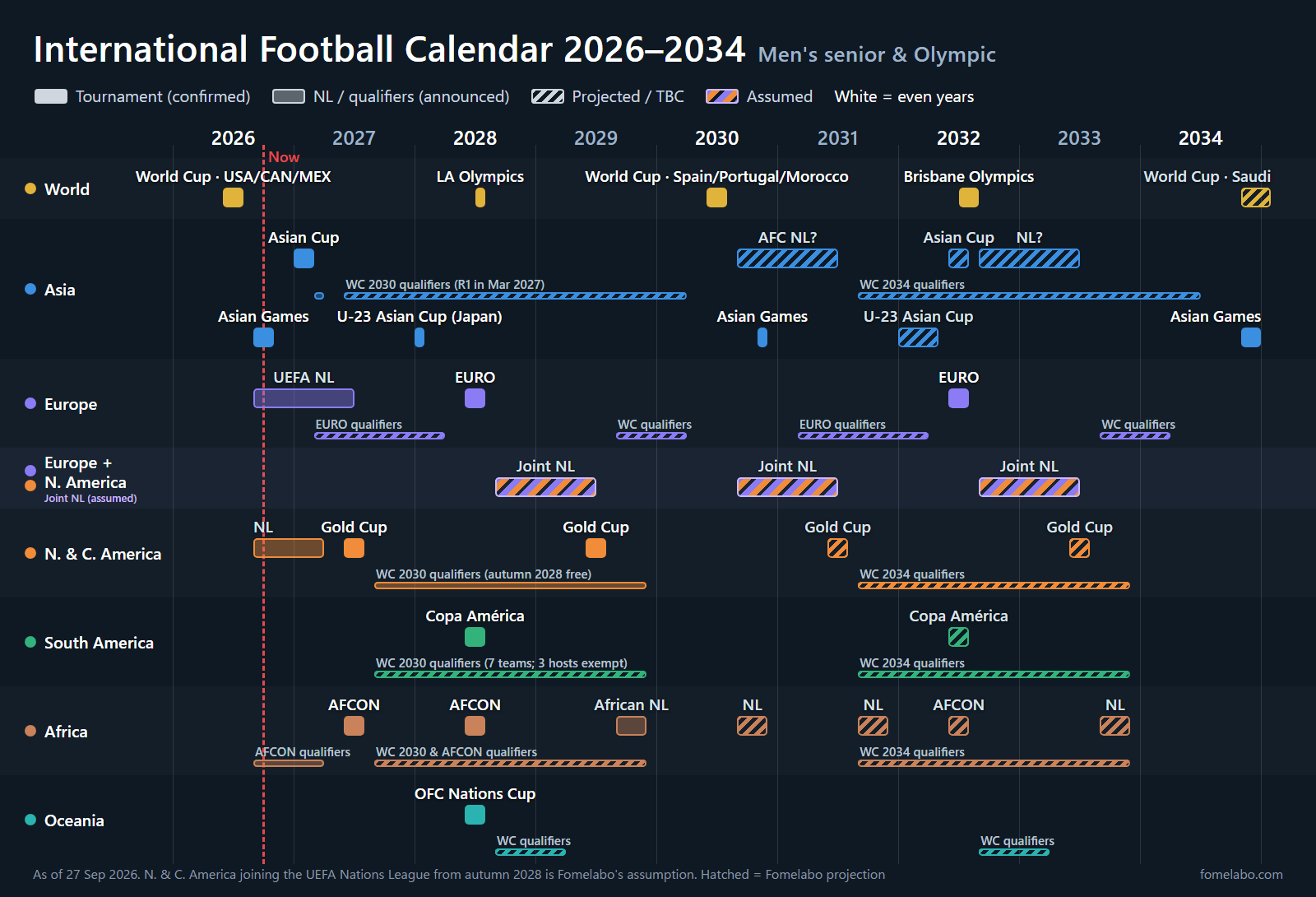
The Asian Cup is moving to even-numbered years from 2032, and the AFC has decided to launch a Nations League. With the international windows filling up with competitive matches, we expect Japan's friendlies to drop sharply and games against South American and European sides to all but disappear. This column separates what has been decided from what we project, explains why football is heading this way, and lays it all out next to the world's other major tournaments.
The chart above lines up the world's major men's international tournaments and each confederation's World Cup qualifiers. World Cups, EUROs and Copa Américas cluster in the summers of even-numbered years, and from 2032 the Asian Cup joins them. We assume North and Central America join the UEFA Nations League from autumn 2028 (UEFA and CONCACAF are in talks). Hatched bars are Fomelabo projections or events whose dates are not yet fixed.
What changes: the facts
| Item | Fact |
|---|---|
| Asian Cup | Bidding for 2031 and 2035 halted. Moving to even-numbered years from 2032 (AFC, March 2026) |
| AFC Nations League | New competition for all 47 member associations. Format and start date not yet decided (AFC, December 2025) |
| International windows | Fixed until 2030 at four windows and up to 10 matches a year. From 2026, September and October merged into one window of up to four matches (FIFA) |
| Africa | AFCON every four years after 2028. African Nations League from 2029 (September to November) (CAF, December 2025) |
| Europe & N. America | UEFA and CONCACAF discussing a joint Nations League, from autumn 2028 at the earliest. The AFC is reportedly interested in joining later (reports, August 2026) |
| South America | World Cup qualifying is a 10-team round robin of 18 matches. Last time it used almost every window from September 2023 to September 2025, apart from those before the Copa |
What we expect
| Projection | Details |
|---|---|
| Far fewer friendlies | Around 16 in 2027-2030, around four in 2031-2034 (see the chart below). Autumns go to the Nations League, the following years to qualifiers |
| Inter-continental matches almost vanish | South America, Europe, North America and Africa also fill their windows with their own competitive matches. The only gap is the autumn right after a World Cup, and that autumn becomes Nations League time too |
| Autumns against Asian teams | September to November is Nations League football. Home opponents are Asian, and away trips to West and Southeast Asia increase |
| Fewer Kirin Challenge Cup games | Home friendlies are limited to slots such as June in years when Japan are not in the Nations League finals |
| Inter-continental matches come back another way? | If the AFC joins a Europe-North America Nations League, Japan could one day play European and North American teams in a competitive match |
This autumn is the exception. Japan's six matches from September to November are all against non-Asian teams: Uruguay, Venezuela, Ecuador, Panama or New Zealand, Brazil and Paraguay. That is only possible because the World Cup has just ended and South American qualifying has not started. Even so, European teams have all six autumn dates taken by the UEFA Nations League, and there is not a single European opponent on the list.
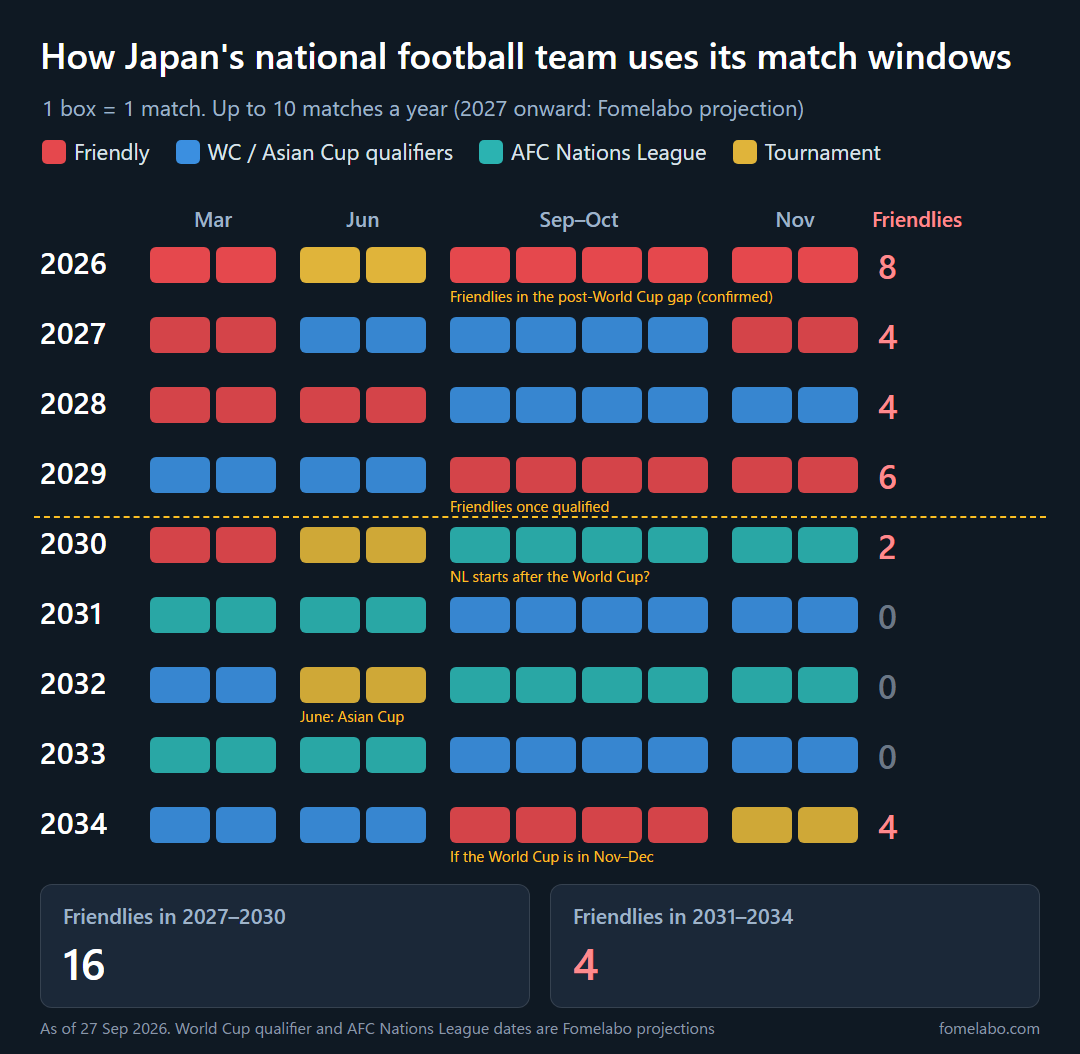
Assumptions: 2030 World Cup Asian qualifying keeps last cycle's format (six matches in the second round, 10 in the final round); the AFC Nations League uses groups of four with six home-and-away games, knockouts the following March and finals in June. In years when Japan miss the Nations League finals, the two June slots return to friendlies.
Why football is heading this way
| Reason | Details |
|---|---|
| The number of slots won't grow | International windows are fixed at 10 matches a year, and clubs and players' unions oppose any increase. Confederations want the limited slots to go to meaningful matches |
| Friendlies barely count in the rankings | FIFA ranking weights: friendlies 10, Nations League 15, its finals and qualifiers 25, continental finals 35-40. World Cup draw pots are based on the ranking, so competitive matches pay off |
| Money can be sold centrally | Each association sells friendly broadcast and sponsorship rights on its own. A Nations League lets the confederation sell a whole competition. In Europe, UEFA already sells national team rights centrally |
| No opponents, high costs | The AFC's own reasons. Smaller Asian nations struggle to attract strong opponents and travel is expensive. A league offers competitive matches against teams of similar level |
| Aligning continental championships | FIFA asked the AFC to move the Asian Cup to even years. If every confederation follows the same rhythm — tournament in an even year, Nations League that autumn, qualifiers the next year — a global Nations League becomes easier to build |
| For Japan | Details |
|---|---|
| Upside | Competitive football in the autumn too, which helps both development and the ranking. Experience of winning away in the Middle East |
| Downside | Fewer chances to face the South American and European powers Japan meet at World Cups. European-based players travel across Asia more. Fewer big-ticket friendlies at the National Stadium and other large venues |
Japan's year (the standard pattern for 2026-2030)
 Japan involvedInternational windows2 matches in March, June and November; 4 in September-October (up to 10 a year)
Year-by-year calendar, 2026-2034
Until 2030, Japan will keep fitting friendlies in between World Cup qualifiers. The change comes after the 2030 World Cup: we expect a two-year cycle like Europe's, with the Nations League in the autumn of a tournament year and qualifiers the year after.
Japan involvedWorld Cup (USA, Canada, Mexico)June 11 - July 19Kirin Challenge Cup, Kirin CupUruguay W 3-1, Venezuela, Ecuador, final or third-place matchAsian Games (Aichi-Nagoya)U-21 team in the semi-finals. Final on October 3Singapore tourAgainst Brazil and ParaguayAsian Cup (Saudi Arabia)January 7 - February 5. Japan in Group F (Indonesia, Thailand, Qatar)FriendliesJapan are not in the first qualifying round2030 World Cup Asian qualifyingFirst round in March (lower-ranked teams); Japan enter in the second roundU-23 Asian Cup (in Japan)Asian qualifying for the LA Olympics2030 World Cup Asian qualifyingSecond round, then final roundLA OlympicsJuly 10-29 (men's final July 28)2030 World Cup Asian final roundQualification decided by JuneWorld Cup (Spain, Portugal, Morocco)June 8 - July 21. Centenary matches in three South American countriesAFC Nations League (first edition)League phaseAsian Games (Doha)November 4-19, U-23AFC Nations LeagueKnockouts and finalsAsian Cup / 2034 World Cup Asian qualifyingU-23 Asian CupAsian qualifying for the Brisbane Olympics. Dates to be decidedAsian CupHost to be decided. June-July most likely (January possible if held in West Asia)Brisbane OlympicsJuly 23 - August 8AFC Nations League (second edition)League phaseAFC Nations LeagueKnockouts and finals2034 World Cup Asian qualifying2034 World Cup Asian qualifyingFinal stagesWorld Cup (Saudi Arabia)November-December or January 2035. Overlaps Ramadan (mid-November to mid-December)Asian Games (Riyadh)November 29 - December 14Men's competitions. As of September 27, 2026. Hatched bars (projected / TBC) are Fomelabo's own projections and will change with AFC and FIFA announcements. FIFA has not published the international match calendar beyond 2030. The Japanese flag marks competitions Japan take part in (for the World Cup and Olympics, assuming they qualify). Sources: AFC, FIFA, CAF, CONCACAF, UEFA, LA28, JFA, Soccer King, The Guardian, Wikipedia.
Read: Japan 3-1 Uruguay (Sep 24) lineups and formationsSee the Asian Cup all-time results (1956-2027)Build your own Japan formation on Fomelabo